
Friday, 8 February 2013
Best gaming blog

Thursday, 7 February 2013
Honavar.......
The present town of Honavar first appears to be mentioned under the form 'Naour' by the Greek author Periplus of the Erythraean Sea (A.D.247) who called it the first port of Limurike, the Tamil country. Next, it appears as 'Hanuruha Island', the seat of an independent chief in the ancient Jain Ramayana. The manuscript was composed in the 10th century in old Kanarase by the poet Pampa (A.D. 902-943). The Arab geographer, Abul Fida (A.D.1273-1331) has mentioned the name of the town. In 1342 the African traveler, Ibn Batuta describes it as the city of Honavar or Hinaur.
According to Ibn Batuta, the people of Honavar were Muslims of the Shafai or Arab sect, peaceful and religious. The men were famous sea-fighters and the women were chaste and beautiful. Most of them knew the Koran by heart. There were twenty-three schools for boys and thirteen for girls. The ruling chief was Jamal-ud-din Muhammad Ibn Hassan. He was subject to an infidel king named Hariab, that is Harihara or Haripappa ofVijayanagar
(A.D. 1336-1350). The princes had an army of six thousand men. However, the people of Malabar, though a courageous and a war-like race, feared the chief for his bravery at sea and paid him tribute. Ibn Batuta went to Calicut and then returned to Honavar where he found the chief preparing an expedition against the island of Sindabur or Chitakul (present day Sadashivgad) near Karwar.
© NR Kamath
Handmade transportation boats parked at Honavar Harbor
Trade
During the 15th century, Honavar was a great place of trade and the Persian ambassador Abd-er-Razzak ( A.D. 1444 ) mentioned it as 'Hanur'. According to the Portuguese historian Faria Y. Souza it was the Moors of Honavar who held Goa against the Bahamani
general Malik-ul- Tujar. In spite of their victory, the Bahamanis placed such restrictions on the trade of the Vijayanagar part that in 1479 the Moors of Honavar left their homes and settled in Goa.
The Italian traveler Varthema (A.D. 1505) describes the town as 'Onor' being located at a day's travel from Anjidiv and ruled by a pagan prince who was subject to the eighth Vijayanagar king Narsinhga (1487-1508). "He was a good fellow, and a great friend of the Portuguese. He went around naked except a cloth around his waist. He had eight ships which were always cruising about. The air of the town was perfect and the people long-lived. There were wild hogs, stags, wolves, lions, peacocks, parrots, and numerous strange birds. People ate beef or sheep meat. Red cows and sheep were in abundance. Throughout the year the rice and roses were available in large quantities."
The Portuguese traveler Barbarosa (A.D.1514) called it the good town of 'Honor' locating it to be on the river beyond Mirjan and near the sea. The Malabaris called it 'Povaran' (that is 'Poavar', as the letters 'H' and 'P' change in accord with the usual old Kanarese rule). Malabaris came to Honavar bringing coconut-oil, palm-molasses, and wine and carried back cheap brown rice. In 1547 the Portuguese had factories at Honavar. In1554 the town is mentioned in the 'Mhit' in the Turkish Seaman's Guide, as a regular place of trade with Aden.Destruction
In 1568, Don Luiz Athaide, the twelfth Portuguese viceroy, besieged the town and built a fortress on the river. The queen of Honavar, with the help of Adilshah, tried to reconquer it but failed. Don Luiz went with a fleet to Honavar and destroyed all its warships. After a week of resistance people left from this rich and thickly populated town. The city was then sacked and reduced to ashes.
Later, in1590, De Barres mentions the city of Honavar as the head of the kingdom of Batikala. The Dutch traveler Jean Hugues de Linscot mentions the existence of a Portuguese fort at Honavar. The famous English sailor, Captain Davis, mentions Honavar as a chief place of trade. The Italian traveler Pietro Della Valla found two churches in the town, one dedicated to St. Katherine and the other to St. Anthony. The ruler of the town was Venkatappa Naik and in the treaty made with the Portuguese in 1631, he took off duties on the export of pepper. Within a gunshot of Honavar was a big Hindu city called the Brahman's City.
In 1720 Hamilton noticed 'Onor' as a port with a river able to receive ships of 200 to 300 tons. In 1727 a small English factory, subordinated to Tellichari was opened at Honavar. In November 1751, under the treaty of Bednur's ( Keladi ) chief, the English were allowed to build a factory on the site of the old factory. The English representative, Stracey, presented himself before Hyder Ali in Bednur and was allowed to continue the trade. The factory procured every year about 210 tons of pepper.Tumulus History of Honavar
Hyder Ali
, in 1763, made up his mind to make Bednur his head-quarter and prepared dockyards and naval arsenals at Honavar and Mangalore. In the year 1769 the English sent a squadron of ships with 400 Europeans and a large body of Sepoys to attack Hyder's sea-ports. At Honavar Hyder's naval captains were so displeased because they had given the command to a cavalry officer that joined the English army. In May of the same year Hyder's troops appeared and took over Honavar's fort and Basavarajdurga. This island is located a little to the South of Mirzunand, is round and about a mile in diameter, rocky, barren and so strong as deemed to be impregnable.
Tippu Sultan
demolished the town in1784 though underHyder Ali
it was a place of great commerce with a naval dockyard. After Tippu Sultan's death, in1799, only five shops were open. In 1800 Munro found not a house at Honavar though it was once the second place of trade in the province of Kanara. In 1801 Buchanan notes that a few people had made offers to rebuild the city if the Government would help. Merchants started to appear from their hiding places and to return from the countries where they had fled.
The pirate crafts of the Malbar coast were a great hindrance to trade. They roved around Pigeon Island, about twenty-five miles South-West of Honavar and had even the impertinence to enter the river and inlets. Eight days before Buchanan came into town the pirates carried off two boats from Honavar creek. He found the wrecks of some of Tipu's ships which were sunk in1783 after the fort was taken by assault.
In 1855, before North Kanara was transferred to the Bombay presidency, Honavar was a zillah (country) station, the head-quarters of a sub-collector, a civil and a session judge. It had a population of 11,968.
Honavar is ideally located to become a river-sea resort. The city is divided into two parts. The smaller one occupies the narrow hill along the South base of a spur, with the houses standing in enclosures shaded by coconut, jack, mango, and other trees. The larger part of the town lies on the North side of the spur. It consists of two long, narrow streets that cross at a right angle, one facing north and south and the other east and west. The houses are raised on a high basement and some have an upper floor. They are generally of stone, most of them built with mud and thatched, and a few with mortar in the walls and with tiled roofs. A Portuguese warehouse was located to the south-east of the port and is known as 'Faringi Bhat' or 'Karkhana'. Traces of the foundations of the old fort still appear on the west side of the spur. The fort had a wall, a moat and is said to have been armed with guns. Its water supply was from a tank to the north-west of the fort which is still called 'Kotekere'.
A perennial cistern is located on the northern side of the town and is known as 'Ramateertha'. In 1623, the Italian traveler, Della Valle visited the spring and described it it as a stream of warm water falling into a beautiful stone cistern. In 1720 Hamilton calls it the Pagoda or temple of Ramteertha which was visited yearly by large numbers of pilgrims. Close by the temple was an oblong cistern fed with water from the face of a rock as large as a man's thigh. About fifty rock-cut steps led to the cistern. At the foot of the steps was a small summer house.
The cistern was about three fathoms deep in the middle and was populated with numerous brown fish that had a white stroke from head to tail on either side of the backbone. When any musical instrument was played, the fish came up in such numbers towards the music that they could be taken in baskets. However they were regarded as holy and no one was allowed to meddle with them.
Sometimes the image of the God was carried in procession. The God appeared to be more like a monkey than a man. They put him in a coach in the form of a tower with a pyramidal top about fifteen feet high and eight to ten priests were sat to bear the image company and to sing his praises. The coach had four wheels and was fastened by a thick rope. It was drawn through the streets by a great mob. It may be recalled that even today (Year 2000), a car festival is held in Honavar on the birthday of LordRamachandra
.
The Temple Chariot at Honavar
*"..they put God in a coach and sang his praises"*
- Italian Traveler Della Valle, 1623
See Also: Car festivals of India
On the opposite hillock from the Ramateertha, the British have erected a thirty-six feet colossal column in the memory of Colonel Hill. He was an infantry commandant and fought against the Mysore army. He was killed in action ( 01/20/1854 ) at Gerusoppa, just eighteen miles from Honavar. His body is buried at Honavar where his memorial
was built in 1854.


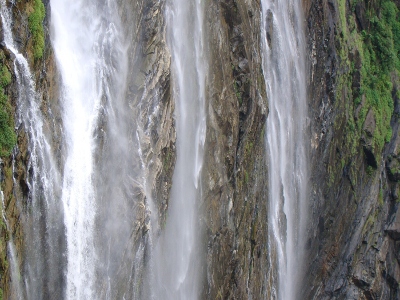
7 DANGEROUS ACTS NOT TO TRY AFTER A MEAL

1. Don’t smoke —- Experiments from experts proves that smoking a cigarette after meal is comparable to smoking 10 cigarettes (chances of cancer is higher)
2. Don’t eat fruits immediately — Immediately eating fruits after meals will cause stomach to be bloated with air. Thre fore take fruits 1 -2 hours after meal or 1 hour before meal.
3. Don’t drink tea—— Because tea leaves contain a high content of acid. This substance will cause the protein content in the food we consume to be hundred thus difficult to digest.
4. Don’t loosen your belt———- Loosening the belt after meal will easily cause the intestine to be twisted and blocked.
5. Don’t bathe———- ——- Bathing after meal will cause the increase of blood flow to the hands, legs and body thus the amount of blood around the stomach will therefore decrease, this will weaken the digestive system in our stomach.
6. Don’t walk about———- — People always say that after a meal walk a hundred steps and you will live till 99. In actual fact this is not true. Walking will cause the digestive system to be unable to absorb the nutrition from the food we intake.
7. Don’t sleep immediately—- ——– The food we intake will not be to digest properly. Thus will lead to gastric and infection in our intestine.
15 GREAT THOUGHTS BY CHANAKYA

1) "Learn from the mistakes of others... you can't live long enough to make them all yourselves!!"
2)"A person should not be too honest. Straight trees are cut first and Honest people are screwed first."
...
3)"Even if a snake is not poisonous, it should pretend to be venomous."
4)"There is some self-interest behind every friendship. There is no friendship without self-interests. This is a bitter truth."
5)" Before you start some work, always ask yourself three questions - Why am I doing it, What the results might be and Will I be successful. Only when you think deeply and find satisfactory answers to these questions, go ahead."
6)"As soon as the fear approaches near, attack and destroy it."
7)"The world's biggest power is the youth and beauty of a woman."
8)"Once you start a working on something, don't be afraid of failure and don't abandon it. People who work sincerely are the happiest."
9)"The fragrance of flowers spreads only in the direction of the wind. But the goodness of a person spreads in all direction."
10)"God is not present in idols. Your feelings are your god. The soul is your temple."
11) "A man is great by deeds, not by birth."
12) "Never make friends with people who are above or below you in status. Such friendships will never give you any happiness."
13) "Treat your kid like a darling for the first five years. For the next five years, scold them. By the time they turn sixteen, treat them like a friend. Your grown up children are your best friends."
14) "Books are as useful to a stupid person as a mirror is useful to a blind person."
15) "Education is the Best Friend. An Educated Person is Respected Everywhere. Education beats the Beauty and the Youth."
Wednesday, 6 February 2013
"Karavali Art and Culture"
*Yakshagana:* The YAKSHAGANA, a form of rich folk dance – drama is an unsurpassed way of exhibiting the themes taken from the epics. Though it can be regarded as a form of folk art, it is far more comprehensive, illuminating and trustworthy than any other form of folk art. Over the ages, Yakshagana has been the vehicle of arts, culture and didactic instruction in the rural areas.
The term ‘gana’ signifies music and as such Yakshagana means a particular style of music, with characteristics of its own, distinct from the other two types Indian music, Hindustani and Karnataka. In course of time, plays in this style came to be known as ‘Yakshagana Prasangas’.Click on Image to Enlarge
**
*Costumes and Makeup:*Yakshagana, as a medium of presenting the religious appeal through the depiction of various events, from the epics like Mahabharata and Ramayana, includes the characters that we never come across in real life. The Gods, divinities, demons, avatars or the incarnation of Gods and Goddesses, takes the viewer to a distinct dream world. The costumes and makeup are the creations of the creative genius, which totally leads the viewer on real life like imagination. The mythological characters are depicted with elaborate costumes and makeup.
A few Categories on types of costumes and makeup can be classified as,
* Valiant heroes or warriors like Karna, Arjuna, Gods and God incarnates which depict great battles fought and deeds of honor
* Characters such as Indra, Gaya etc. too valiant, quite often flamboyant, vain or even silly
* Rakshasas and Rakshasis (Demons) who signify strength, valor etc. but evil and cruel by nature. More often they are personalities which strike terror into the hearts of people
* Gods and Goddesses who take up destructive roles in order to crush evils and sin, when everyone else has failed to control the evil like Durga, Chandi, and Narasimha etc.
* Intermediate characters, which are beasts in, shape but very human in nature like Hanuman, Vali, and Janbava etc.
* Sages, Gurus and Brahmins
* Hasyagara (Hanumanayaka) who appears mostly as a servant or messenger and is a person of mundane realistic garb.
Headgears consist of crowns particularly built up mundasas, or turbans. These crowns are made of wood set which rich decorative materials consisting of bits of mirror and gold/silver paper. The crown is a symbol of sovereignty and normally all kings wear them. There is a second type of crown worn by demonical roles, which is large in size and having different decorative patterns consisting of Gold foil, a colored plate disc in front along with ear ornaments. It may be remembered that large number of headgears like the Rakshasa are quite heavy to carry. It is extremely difficult to carry these weights and intricate dance movements.
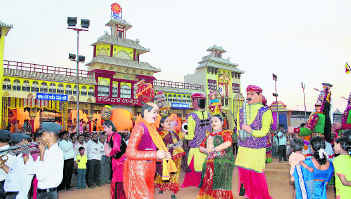
Many Yakshagana performances are staged in open air during the night and are also recognized by the name Dashavatara Ata or Bayalata. Ata in Kannada means play. The play begins with a prologue called ‘Sabhalakshana’. By the time ‘Sabhalakshana’ comes to an end, the village audience would all have gathered and it is time to start the ‘Prasanga’. The performance continues till the break of dawn. The stage is constructed in an open area like paddy field or temple yard and is a place easily accessible to all. This stage is called as ‘Rangasthala’.
Behind the stage is a raised bench, or a table or two, are placed for the ‘Bhagavata’ and his accompanists called ‘Himmela’. At the right hand corner sits the man who plays ‘Chende’. Chende is a high-strung drum played with two sticks and can be heard from a great distance. A drummer giving a vibrant background to the entire show also plays another drum known a ‘Maddale’.
In Yakshagana, it has been the custom from time immemorial, for the males to play both male and female roles. The Bhagavata is an anchorperson of Yakshagana performance; traditionally he is a leader of the troupe. He is also responsible for discipline, control among the artists and guides the artists about the script or Prasanga, the background story and the role of each character and their responsibilities.
**
*Kola – Ritual Theatre: *The Tulu speaking people of South Kanara have preserved their distinct culture, language and social values which can be widely seen even today. The folk rituals and beliefs reflect the socio-economic order, artistic values and culture connected to the ancient society. The ‘Bhotha Kola’ or the spirit worship is an important socio cultural phenomenon of South Kanara. As a possession cult and folk ritualistic theatre it is to be viewed as a complex system of rituals and beliefs, music and narratives, dance and dialogues, social gatherings and entertainment, miraculous healing of physical and mental disorders and setting of disputes and quarrels all rolled into one.Click on Image to Enlarge
Click on Image to Enlarge
‘Bhotha’ is a Sanskrit term signifying the elements of nature earth, water, fire, air and space. It also means the unseen spirit. With this in mind people began worshipping, a practice known as ‘Bhoothaaradhane’. It is not just an elaborate ritual but is also a rich form of visual and performing arts, which is associated with this cult. The spectacular dance by the priest-impersonator possessed by the spirit wearing gorgeous costumes, masks, making awe inspiring cries and performing miracles and heroic feats and delivering the message of the divine spirit, curing disease and settling village disputes – all these leave a lasting impression on the spectators. It is believed that ‘Bhootha’ or the spirit treats human beings as their foster children and act as a bridge between human beings and God. In return they expect their devotion and customary offerings.
The origin of this cult can be traced to the concepts of totemism and ancestor worship. Some spirits are of animistic origin while certain others are the legendary heroes or other historical figures, which met with tragic death and hence attained divinity.
Spirits like Panjurli, Pilichandi and Nandigone indicate their totemistic origin from pig, tiger and bull. Jumadi, Mariamma etc. are connected with puranic deities. Jumadi is considered half male and half female. There are also certain other spirits of native origin like ‘Koti Chennaya’, ‘Kalkuda’ Bobbarya and ‘kordabbu’ etc. ‘guliga’ and Chaundi’ are ferocious spirits and in the ceremonies associated with them, sucking of live blood from chicken may be observed. There are about four to five hundred spirits, but only twenty-five are more popular and worshipped in all parts of South Kanara. Other spirits are worshipped by certain individual families or in certain regions in a modest way.
**
*Pad-danas -* *Oral epics*:* *Narrated in Tulu language, Pad-danas refer to historical and mythological events of the region at different periods, thereby serving a useful source of information to a historian. Pad-danas are narrated in ballad-loke folk epics of varying length. These ballads, which were handed over through oral traditions, arepics pl especially sung especially by the community of impersonators together with the rhythmic beats of a small drum known as ‘tembare’.
The folk form and music in the ritual art of Bhoothakola is very prominent and contribute significantly to the cultural edifice of folk arts. The impersonators are born singers and they inherit the knowledge of melody and rhythm and undergo training in voice culture with their parents. The Pad-danas are sung in high octave in front of the image of the spirit. Musicians form an integral part of the whole ritualistic performance. Only men act as spirit impersonators even in the case of female spirits.Click on Image to Enlarge
*Nagaaradhane – Serpent Worship:*In coastal Karnataka, both Tulu speaking areas as well as Kannada speaking areas, Serpent worship is performed with great pomp and reverence. The propitiation of serpent is believed to give them wealth, health and offspring’s. Stone slabs with figures of serpents carved on them are installed and worshipped in a bush, or under a tree.
Apart from the periodical worship of these serpent stones, the devotees also arrange for a big ritual called ‘Nagamandala’, to fulfill their vows, to obtain desired boons and for the welfare of the community. A representation of serpent spirit is made on the floor by using powders of different colors. These colors are made from indigenous objects such as dried leaves, saffron and rice powder etc. The picture of the serpent will represent several hoods in odd numbers along with wavy movements of the serpent body. This ceremony beginning at around 9.00pm lasts throughout the night. The two important characters in the ballet like dance drama are the ‘Nagapaatri’ possessed by the serpent spirit and the other in the role of serpent maiden ‘ Nagakannike’. The craftsmanship involved in deep and fascinating color combination of the madala design, the terrific as well as graceful dance drama of the Naga artists accompanied by music, final oracle and divine message create a lasting impression on the minds of the devotees.

Karavali Sports.....
Folk Sports
The people of South Kanara whose main occupation has been traditionally agriculture, have different modes of entertainment to coincide with different seasons of the year. Among them, the buffalo race, popularly known, as ‘Kambala’ is the trademark sport of the region, and the Cockfight, better known, as ‘Korikatta’ in local language are important folk sports.
Kambala – The Buffalo race:Kambala, the most beautiful sport dear to the cultivating community – in simple way means the racing of buffalos in wet fields. Since the weather of this region is tropical, the buffalo race is usually held after the rainy season.
History tells us that Alupa Kings, who ruled the region between 12th and 17th centuries, were the first to introduce Kambala to the Tulu region for the purpose of entertainment. Since then this rural sport has grown in popularity and attracts a huge number of spectators to witness the show that highlights tremendous energy, performance, speed and training.
The venue of Kambala is a veritable canvas offering an interesting spectacle – from a man walking with a pair of buffaloes, blowing of horns, the brass band playing, and curious viewers. Various stalls and the racing field. The event pulls visitors and spectators from all surrounding villages and towns that converge at one single place – Kambala.
The racing field is thoroughly ploughed and properly leveled with one-foot level of water covering it. The twin racing tracks are known as ‘Jodukere Kambalas’. The stretch of the racing track in full-fledged Kambalas is 450 ft long and the destination is known as ‘Manjotti’, which slopes upwards to reduce the speed of the galloping buffaloes.
There are various types of Buffalo races with a certain pair being trained for a particular race. Full fledged Kambalas usually have three types of competition namely,*Haggada Ota or Rope race*, *Kene Halaga Ota or Wooden ply race*,*Halage Ota or leveler plank race.**
*
In the *Haggada Ota* or *Rope race*, the Pane is tied along with the yoke and the rope in between the two buffaloes, while the racer holds the rope. The pair reaching the destination first is declared as the winner.
In the *Kene Halaga Ota or wooden ply race*, the wooden ply is tied to the yoke and the racer keeps one foot or both feet on the wooden ply. Depending on the speed the buffaloes sprint splashes of water emant through the holes made through the ply. This is a spectacular race and the water splashes to a height of 10 – 15 ft.
In *Halage Ota* or *Leveler plank race*, the T Shaped wooden plank is tied between the buffaloes and the racer stands on the planks holding the rope and races. Here two pairs are made to run parallel and the victory belongs to the pair reaching the manjotti first.
Korikatta – Cockfight: Although in existence in ancient places like Rome and Greece, Korikatta is a more popular entertainment among the rural folk. The cocks used for the fight are carefully selected from good breed. While selecting the cocks equal attention is paid for the feather color, physique and age of the cocks. They are given initial training through mock fights with other cocks.
Initially pair of Cocks is chosen to fight each other while the spectators form a circle around the fighting arena. A sharp knife ‘Bal’ about 2-5 inches long is tied to the leg of each cock and thus they are prepared for the fight. This sport may be organised during day time under legal norms strictly without betting. Fights continue in a highly charged atmosphere and the cocks are held in opposite direction. They are enraged and made ferocious and they jump and kick at each other. The ‘Bal’ tied to the leg sometimes injures one cock or both. Sometimes the cocks suddenly runaway from the fight. The injured cocks are treated with medicine, stitches etc. and are made ready for next round of fight. The victory is decided when a cock runs, collapses or dies. The defeated cock is used in cooking a handsome meal to be shared with family and friends and is a moment to cherish.


Tuesday, 5 February 2013
"Nathuram Vinayak Godse's Last Speech"
'THE
REAL HERO' - Nathuram
Vinayak Godse.His Last
Speech:ANUARY 30th,
1949 - The Mahatma
was assassinated by a
man called Naturam
Godse.After he shot him,
instead of running away,
he stood his ground and
surrounded. He said,
"No one should think
that Gandhi was killed
by a madman"One of
the best speeches of All
time, which is compared
to Socrates's speech in
his trial. The Judge was
astonished by his
speech and commented
that if India had
followed the Jury system
of giving judgments,
Godse would have been
adjudicated as "Not
Guilty" by the Jury,
cause after the speech,
the whole audience was
in tears.This is the
speech given by
Nathuram Godse in the
court in his last trial for
the murder of Mahatma
GandhiBorn in a
devotional Brahmin
family, I instinctively
came to revere Hindu
religion, Hindu history
and Hindu culture. I
had, therefore, been
intensely proud of
Hinduism as a whole. As
I grew up I developed a
tendency to free
thinking unfettered by
any superstitious
allegiance to any isms,
political or religious.
That is why I worked
actively for the
eradication of
untouchability and the
caste system based on
birth alone. I openly
joined anti-caste
movements and
maintained that all
Hindus were of equal
status as to rights, social
and religious and should
be considered high or
low on merit alone and
not through the accident
of birth in a particular
caste or profession. I
used publicly to take
part in organized anti-
caste dinners in which
thousands of Hindus,
Brahmins, Kshatriyas,
Vaisyas, Chamars and
Bhangis participated. We
broke the caste rules
and dined in the
company of each other.I
have read the speeches
and writings of
Dadabhai Nairoji,
Vivekanand, Gokhale,
Tilak, along with the
books of ancient and
modern history of India
and some prominent
countries like England,
France, America and'
Russia. Moreover I
studied the tenets of
Socialism and Marxism.
But above all I studied
very closely whatever
Veer Savarkar and
Gandhiji had written
and spoken, as to my
mind these two
ideologies have
contributed more to the
moulding of the thought
and action of the Indian
people during the last
thirty years or so, than
any other single factor
has done.All this
reading and thinking led
me to believe it was my
first duty to serve
Hindudom and Hindus
both as a patriot and as
a world citizen. To
secure the freedom and
to safeguard the just
interests of some thirty
crores (300 million) of
Hindus would
automatically constitute
the freedom and the
well being of all India,
one fifth of human race.
This conviction led me
naturally to devote
myself to the Hindu
Sanghtanist ideology
and programme, which
alone, I came to
believe, could win and
preserve the national
independence of
Hindustan, my
Motherland, and enable
her to render true
service to humanity as
well.Since the year
1920, that is, after the
demise of Lokamanya
Tilak, Gandhiji's
influence in the
Congress first increased
and then became
supreme. His activities
for public awakening
were phenomenal in
their intensity and were
reinforced by the slogan
of truth and non-
violence, which he
paraded ostentatiously
before the country. No
sensible or enlightened
person could object to
those slogans. In fact
there is nothing new or
original in them. They
are implicit in every
constitutional public
movement. But it is
nothing but a mere
dream if you imagine
that the bulk of
mankind is, or can ever
become, capable of
scrupulous adherence to
these lofty principles in
its normal life from day
to day. In fact, honour,
duty and love of one's
own kith and kin and
country might often
compel us to disregard
non-violence and to use
force. I could never
conceive that an armed
resistance to an
aggression is unjust. I
would consider it a
religious and moral duty
to resist and, if possible,
to overpower such an
enemy by use of force.
[In the Ramayana]
Rama killed Ravana in a
tumultuous fight and
relieved Sita. [In the
Mahabharata], Krishna
killed Kansa to end his
wickedness; and Arjuna
had to fight and slay
quite a number of his
friends and relations
including the revered
Bhishma because the
latter was on the side of
the aggressor. It is my
firm belief that in
dubbing Rama, Krishna
and Arjuna as guilty of
violence, the Mahatma
betrayed a total
ignorance of the springs
of human action.In
more recent history, it
was the heroic fight put
up by Chhatrapati
Shivaji that first checked
and eventually
destroyed the Muslim
tyranny in India. It was
absolutely essentially for
Shivaji to overpower and
kill an aggressive Afzal
Khan, failing which he
would have lost his own
life. In condemning
history's towering
warriors like Shivaji,
Rana Pratap and Guru
Gobind Singh as
misguided patriots,
Gandhiji has merely
exposed his self-conceit.
He was, paradoxical, as
it may appear, a violent
pacifist who brought
untold calamities on the
country in the name of
truth and non-violence,
while Rana Pratap,
Shivaji and the Guru will
remain enshrined in the
hearts of their
countrymen forever for
the freedom they
brought to them.The
accumulating
provocation of thirty-two
years, culminating in his
last pro-Muslim fast, at
last goaded me to the
conclusion that the
existence of Gandhi
should be brought to an
end immediately.
Gandhi had done very
well in South Africa to
uphold the rights and
well being of the Indian
community there. But
when he finally
returned to India he
developed a subjective
mentality under which
he alone was to be the
final judge of what was
right or wrong. If the
country wanted his
leadership, it had to
accept his infallibility; if
it did not, he would
stand aloof from the
Congress and carry on
his own way. Against
such an attitude there
can be no halfway
house. Either Congress
had to surrender its will
to his and had to be
content with playing
second fiddle to all his
eccentricity,
whimsicality,
metaphysics and
primitive vision, or it
had to carry on without
him. He alone was the
Judge of everyone and
everything; he was the
master brain guiding the
civil disobedience
movement; no other
could know the
technique of that
movement. He alone
knew when to begin and
when to withdraw it.
The movement might
succeed or fail, it might
bring untold disaster
and political reverses
but that could make no
difference to the
Mahatma's infallibility.
'A Satyagrahi can never
fail' was his formula for
declaring his own
infallibility and nobody
except himself knew
what a Satyagrahi
is.Thus, the Mahatma
became the judge and
jury in his own cause.
These childish insanities
and obstinacies, coupled
with a most severe
austerity of life,
ceaseless work and lofty
character made Gandhi
formidable and
irresistible. Many people
thought that his politics
were irrational but they
had either to withdraw
from the Congress or
place their intelligence
at his feet to do with, as
he liked. In a position of
such absolute
irresponsibility Gandhi
was guilty of blunder
after blunder, failure
after failure, disaster
after disaster.Gandhi's
pro-Muslim policy is
blatantly in his perverse
attitude on the question
of the national language
of India. It is quite
obvious that Hindi has
the most prior claim to
be accepted as the
premier language. In
the beginning of his
career in India, Gandhi
gave a great impetus to
Hindi but as he found
that the Muslims did not
like it, he became a
champion of what is
called Hindustani.
Everybody in India
knows that there is no
language called
Hindustani; it has no
grammar; it has no
vocabulary. It is a mere
dialect; it is spoken, but
not written. It is a
bastard tongue and
crossbreed between
Hindi and Urdu, and not
even the Mahatma's
sophistry could make it
popular. But in his
desire to please the
Muslims he insisted that
Hindustani alone should
be the national
language of India. His
blind followers, of
course, supported him
and the so-called hybrid
language began to be
used. The charm and
purity of the Hindi
language was to be
prostituted to please the
Muslims. All his
experiments were at the
expense of the
Hindus.From August
1946 onwards the
private armies of the
Muslim League began a
massacre of the Hindus.
The then Viceroy, Lord
Wavell, though
distressed at what was
happening, would not
use his powers under
the Government of India
Act of 1935 to prevent
the rape, murder and
arson. The Hindu blood
began to flow from
Bengal to Karachi with
some retaliation by the
Hindus. The Interim
Government formed in
September was
sabotaged by its Muslim
League members right
from its inception, but
the more they became
disloyal and treasonable
to the government of
which they were a part,
the greater was
Gandhi's infatuation for
them. Lord Wavell had
to resign as he could not
bring about a settlement
and he was succeeded
by Lord Mountbatten.
King Log was followed by
King Stork.The Congress,
which had boasted of its
nationalism and
socialism, secretly
accepted Pakistan
literally at the point of
the bayonet and abjectly
surrendered to Jinnah.
India was vivisected and
one-third of the Indian
territory became foreign
land to us from August
15, 1947. Lord
Mountbatten came to be
described in Congress
circles as the greatest
Viceroy and Governor-
General this country
ever had. The official
date for handing over
power was fixed for
June 30, 1948, but
Mountbatten with his
ruthless surgery gave us
a gift of vivisected India
ten months in advance.
This is what Gandhi had
achieved after thirty
years of undisputed
dictatorship and this is
what Congress party
calls 'freedom' and
'peaceful transfer of
power'. The Hindu-
Muslim unity bubble was
finally burst and a
theocratic state was
established with the
consent of Nehru and
his crowd and they have
called 'freedom won by
them with sacrifice' -
whose sacrifice? When
top leaders of Congress,
with the consent of
Gandhi, divided and
tore the country - which
we consider a deity of
worship - my mind was
filled with direful
anger.One of the
conditions imposed by
Gandhi for his breaking
of the fast unto death
related to the mosques
in Delhi occupied by the
Hindu refugees. But
when Hindus in Pakistan
were subjected to
violent attacks he did
not so much as utter a
single word to protest
and censure the
Pakistan Government or
the Muslims concerned.
Gandhi was shrewd
enough to know that
while undertaking a fast
unto death, had he
imposed for its break
some condition on the
Muslims in Pakistan,
there would have been
found hardly any
Muslims who could have
shown some grief if the
fast had ended in his
death. It was for this
reason that he
purposely avoided
imposing any condition
on the Muslims. He was
fully aware of from the
experience that Jinnah
was not at all perturbed
or influenced by his fast
and the Muslim League
hardly attached any
value to the inner voice
of Gandhi.Gandhi is
being referred to as the
Father of the Nation.
But if that is so, he had
failed his paternal duty
inasmuch as he has
acted very treacherously
to the nation by his
consenting to the
partitioning of it. I
stoutly maintain that
Gandhi has failed in his
duty. He has proved to
be the Father of
Pakistan. His inner-
voice, his spiritual power
and his doctrine of non-
violence of which so
much is made of, all
crumbled before
Jinnah's iron will and
proved to be
powerless.Briefly
speaking, I thought to
myself and foresaw I
shall be totally ruined,
and the only thing I
could expect from the
people would be nothing
but hatred and that I
shall have lost all my
honour, even more
valuable than my life, if
I were to kill Gandhiji.
But at the same time I
felt that the Indian
politics in the absence
of Gandhiji would surely
be proved practical, able
to retaliate, and would
be powerful with armed
forces. No doubt, my
own future would be
totally ruined, but the
nation would be saved
from the inroads of
Pakistan. People may
even call me and dub
me as devoid of any
sense or foolish, but the
nation would be free to
follow the course
founded on the reason
which I consider to be
necessary for sound
nation-building. After
having fully considered
the question, I took the
final decision in the
matter, but I did not
speak about it to anyone
whatsoever. I took
courage in both my
hands and I did fire the
shots at Gandhiji on
30th January 1948, on
the prayer-grounds of
Birla House.I do say
that my shots were fired
at the person whose
policy and action had
brought rack and ruin
and destruction to
millions of Hindus.
There was no legal
machinery by which
such an offender could
be brought to book and
for this reason I fired
those fatal shots.I bear
no ill will towards
anyone individually but
I do say that I had no
respect for the present
government owing to
their policy, which was
unfairly favourable
towards the Muslims.
But at the same time I
could clearly see that
the policy was entirely
due to the presence of
Gandhi. I have to say
with great regret that
Prime Minister Nehru
quite forgets that his
preachings and deeds
are at times at
variances with each
other when he talks
about India as a secular
state in season and out
of season, because it is
significant to note that
Nehru has played a
leading role in the
establishment of the
theocratic state of
Pakistan, and his job
was made easier by
Gandhi's persistent
policy of appeasement
towards the Muslims.I
now stand before the
court to accept the full
share of my
responsibility for what I
have done and the
judge would, of course,
pass against me such
orders of sentence as
may be considered
proper. But I would like
to add that I do not
desire any mercy to be
shown to me, nor do I
wish that anyone else
should beg for mercy on
my behalf. My
confidence about the
moral side of my action
has not been shaken
even by the criticism
levelled against it on all
sides. I have no doubt
that honest writers of
history will weigh my act
and find the true value
thereof some day in
future.-NATHURAM
GODSE

Saturday, 2 February 2013
13 STEP TO FACE AFRAID..
Everyone is afraid. I am, you are, everyone is! The only difference between you and the successful people you admire is that they are willing to work and move through their fears in order to get where they want to be.
If you don’t learn how to face your fear
it will grip your mind, body, and spirit. It will wage a war against you and your dreams. Know this need not be. Once you understand how you can dissipate fear, it shrinks and is no longer a threat.
The next time you’re in a scary place try the following exercises.1. Journal your fears
Write about your fear and its origin. How has it held you back in the past? Set aside time and without judgment, reflect on what you’ve written. You gain insight and loosen fears grip by observing it. When you write down your fear, fear loses its power over you.2. Lean into your fear
Do the things that frighten you. Take one small step, then another. Action builds courage. Tell yourself, “This fear will pass.” Your world expands as your courage and willingness to grow expands. Open up your world, today to face your fear.3. Relax your body
Unclench your jaw, soften your forehead, open your fists, slow down your pounding heart, and breathe. Take mini relaxation breaks throughout your day. Learn to live in a relaxed state.4. Journal your past success
We tend to beat ourselves up when we fail and fail to celebrate when we succeed. Strengthen your belief in yourself by reflecting on each decade of your life and every success you’ve experienced. You can begin as early as age five when you learned how to ride a bike. Write it all down. You’ll be inspired, motivated and amazed by your list
and how and can be used to face your fear.5. Stop your story
Fear is an illusion. We make up frightening stories about our past and our future and rehearse them until we are terrified. Our stories are often about the pain of the past or the fear of the future. Change the fearful stories you tell yourself. You can find safety by learning to live in the present moment. You always have the option to create new stories filled with positive expectations of the future.6. Laugh at your fear
Make fun of your fear
by laughing at it. Really let it rip. Try and see how silly it is to hold back and give your power away to something that isn’t real!7. Dwell on abundance
Learn to think, speak, and live as an abundant person to face your fear. Stop paying attention to all forms of negative media. Celebrate your life. Be generous. Give. Donate. Share.8. Live vicariously
Study the success of Victor Frankl, Steve Jobs, Southwest Airlines, J.K. Rowling and other greats. Take note of their bold lifestyle and follow their path to greatness.9. Believe in yourself
Focus your attention on being ready, willing, and prepared for the success, joy, wonder, connections, good fortune, and awesome circumstances that are yours if you are willing to work and be open to it. You deserve the best no matter what. Accept that fact about yourself.10. Learn something new
Do you lack information or direction? Develop your intuition. Get a mentor. Join Toastmasters. Be a life-long learner. Give it your all. Burn the midnight oil. Take action on what you learn. Fear fades in an environment of this kind.11. Take your fear and shove it
Let go of looking stupid, feeling embarrassed, being ignored and facing rejection or failure. Accept failure as a part of life. Get through it and get over it.12. Help others
Give to the beginners. Be a good leader. Take others with you and help them succeed as well. What would life be like if we believed in, “All for one, and one for all?” We all want the same things in life. Let’s help each other move ahead.13. View life as a creative and wild adventure
Life can be brimming with good times of beauty and adventure or overwhelming with challenge and tragedy. Choose to stay present and breathe through it all. Be grateful for the varied landscape, hold onto your hat, and enjoy the ride.


